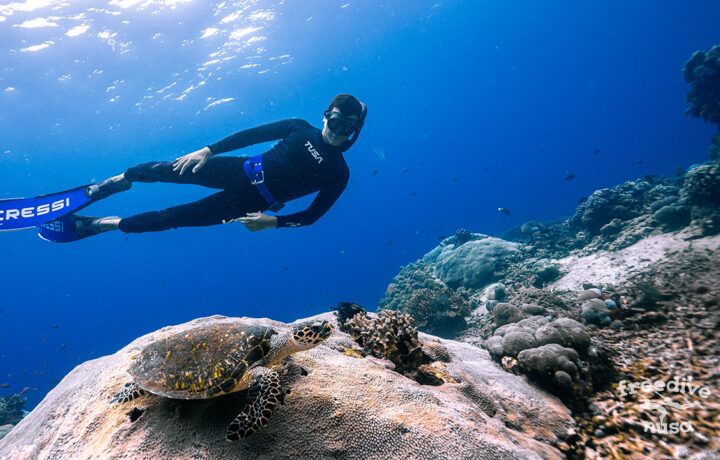
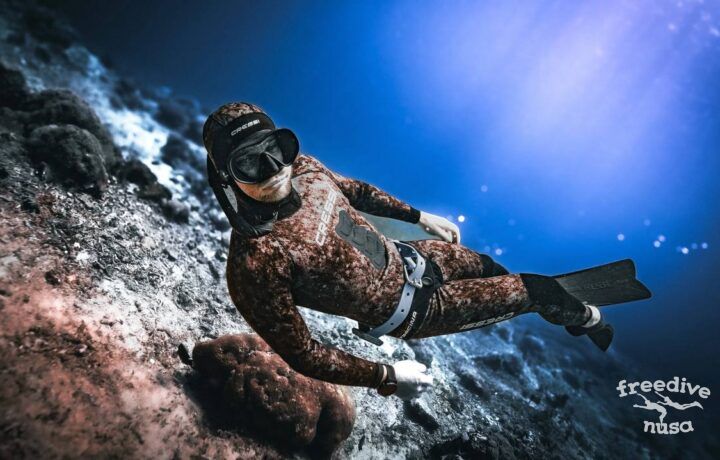
Every freediver remembers their first real descent. The moment when the world above disappears, the light shifts to blue, and you realize you’re somewhere entirely new. That feeling isn’t a modern invention. Humans have been chasing it for thousands of years.
We’ve spent years teaching to freedive, and what continues to fascinate us is that freediving hasn’t changed nearly as much as you might think. The equipment has improved, our understanding of physiology has deepened, but the fundamental act remains exactly what it always was.
The First Freedivers
Long before freediving became a sport, it was a skill as essential as hunting or fishing, passed down through generations with quiet precision.
The earliest evidence takes us to the Aegean Sea. On Kalymnos, sponge diving was a way of life by 3000 BCE. Divers used a skandalopetra (a flattened stone tied to a rope) to reach 30 meters on a single breath. Homer mentions sea sponges in both the Iliad and the Odyssey, suggesting this trade was already ancient in his time.
Half a world away, different traditions took root. The Ama of Japan and the Haenyeo of Korea developed cultures centered on women divers. For over two millennia, these women have harvested the sea. What makes this remarkable is the continuity. On Jeju Island today, you can watch Haenyeo in their 70s and 80s surface with shellfish, exactly as their grandmothers did. UNESCO recognized this culture in 2016, but the divers will tell you they’re not preserving history – they’re just living their lives.
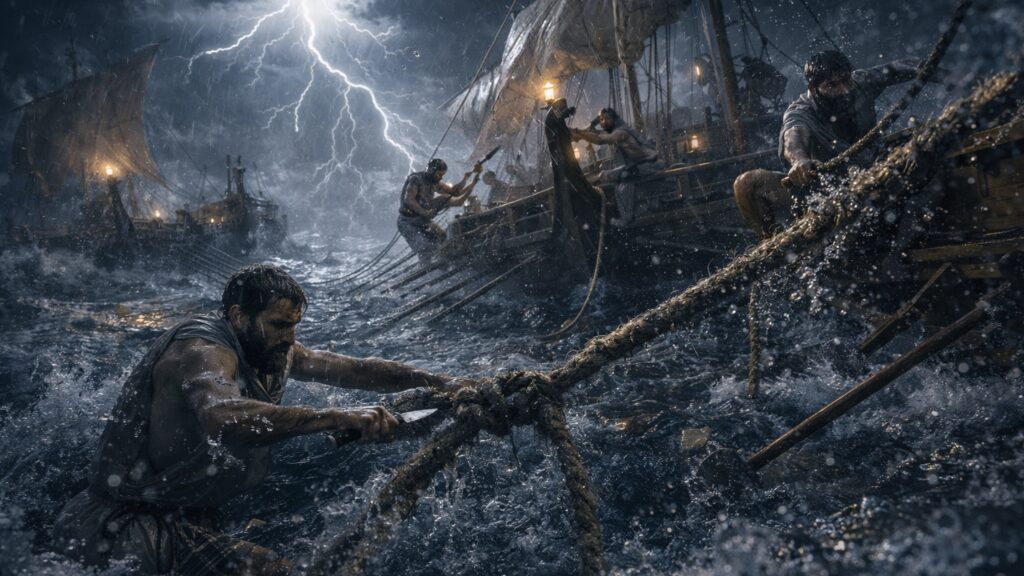
Freediving also had military applications. In 480 BCE, the Greek diver Hydna and her father swam out during a storm and cut the anchor ropes of the Persian fleet, sinking ships. Alexander the Great faced similar tactics at Tyre in 332 BCE, when local divers severed his anchor lines.
The Birth of Modern Freediving
The jump from survival to sport happened surprisingly late, and it happened almost by accident.
In 1949, Raimondo Bucher was an Italian Air Force captain on holiday in Naples. He was also an avid spearfisherman, part of a community that spent countless hours underwater and constantly tested their limits. One evening, Bucher made a claim that seemed absurd even to his fellow divers: he could reach 30 meters on a single breath.
At the time, physiologists believed the human chest would simply collapse beyond 20 or 25 meters. The pressure was too great. Ennio Falco, another diver, took the bet – 50,000 lire. Falco descended with scuba gear and waited at 30 meters. Bucher appeared moments later, swam to the marker, and returned to the surface.
That dive shattered the scientific consensus and ignited something in the freediving community. If 30 meters was possible, why not 40? Why not 50?
What Happens in Your Body
Every time you dive, your body performs a series of coordinated responses that scientists call the Mammalian Dive Reflex. We prefer to think of it as your body remembering something ancient.
Here’s what actually happens:
- Your heart rate slows. This is bradycardia, and it’s immediate. In some divers, heart rate can drop by half within seconds of face immersion.
- Blood vessels in your arms and legs constrict, redirecting oxygenated blood to your brain and heart. Your body knows, instinctively, which organs matter most.
- Then there’s blood shift – the most misunderstood and remarkable adaptation. As you descend and pressure compresses your lungs, blood plasma moves into your chest cavity, filling the space left by the shrinking air. This prevents your lungs from being crushed. It’s something your body already knows how to do.
- Your spleen also gets involved. Think of it as a biological scuba tank. The spleen stores about 200 milliliters of oxygen-rich red blood cells and can release them into circulation during a dive, boosting your oxygen-carrying capacity by 3 to 5 percent.
What this means for you as a freediver is simple: freediving isn’t about overcoming your body’s limitations. It’s about learning to work with reflexes that have been there all along.
Disciplines and the Modern Sport
Few people know that freediving has already been an Olympic sport. At the 1900 Summer Olympics in Paris, competitions were held in “underwater swimming” . Competitors received points for each meter swam underwater and each second they remained submerged. French athlete Charles de Vendeville took gold by swimming 60 meters in 68.4 seconds. However, the discipline was excluded due to safety concerns.
The 1960s and 70s became a golden age of exploration, driven by two men who could not have been more different. Enzo Maiorca was the Italian champion – competitive, disciplined, driven. Jacques Mayol was a French philosopher-diver who studied yoga, spent hours alone in the ocean, and spoke of dolphins as spiritual cousins. Their rivalry captivated Europe. Their records were ratified by CMAS — the World Underwater Federation, founded in 1959 with Jacques-Yves Cousteau as its first president .
But in the 1970s, following several high-profile accidents, CMAS stopped holding freediving competitions, considering them too dangerous . This didn’t stop the enthusiasts. Mayol’s 1976 dive to 100 meters in the No Limits discipline proved that the barrier wasn’t physical; it was mental. The Big Blue movie would later dramatize their story, but the reality was perhaps more interesting: two men, pushing each other deeper, proving that human limits are never as fixed as we imagine.
After the film’s release, interest in freediving exploded, and in 1992, AIDA — the International Association for the Development of Apnea — was founded in Nice. It was created by freedivers to establish standardized rules and safety guidelines for the numerous record attempts occurring worldwide.
Today, both federations coexist, though their relationship is complicated. In 2023, following a doping controversy, CMAS discontinued cooperation with AIDA. Notably, CMAS is the only one of the two officially recognized by the International Olympic Committee and actively lobbies for freediving’s return to the Olympic program.
Today’s competitive disciplines reflect the sport’s diversity:
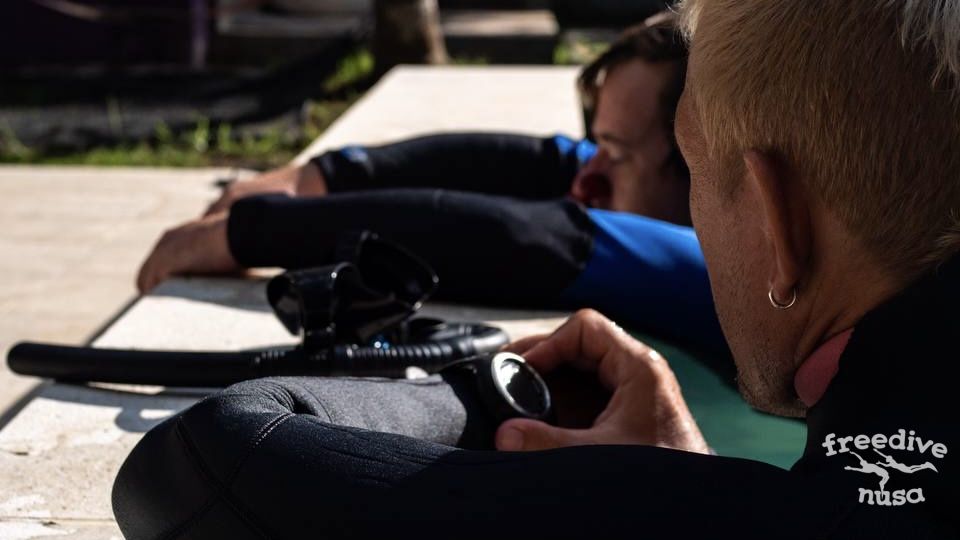
- Pool disciplines are where most students start. Static Apnea teaches you to manage the urge to breathe. The current record of 11 minutes, 35 seconds is less about physical capacity than about mental comfort with carbon dioxide. Dynamic disciplines add movement, with or without fins, teaching efficient technique in a controlled environment.
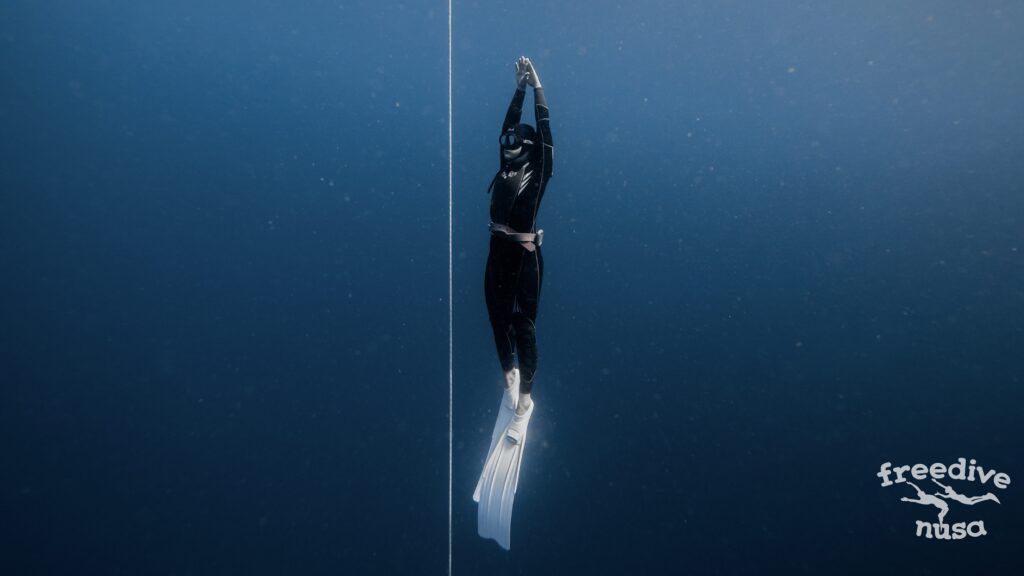
- Depth disciplines are what brought most of us to the ocean. Constant Weight is the sport’s classic expression. Free Immersion, where you pull yourself down and up the rope, is often the first depth discipline students learn because it’s controlled and meditative. Constant Weight Without Fins is the purest form: just you, moving through the water column with nothing but your own strength.
- No Limits, where divers ride a weighted sled down and inflate a balloon to return, produced the sport’s deepest numbers. Herbert Nitsch’s 2007 dive to 214 meters remains the record. But AIDA no longer sanctions No Limits attempts – the risks outweigh the rewards, and the freediving community has shifted focus toward safer, more sustainable exploration.
Where We Are Now
Freediving has grown exponentially in the past decade, and the students walking through our doors today are different from the ones who came 20 years ago.
They’re not all aspiring competitors. Many are photographers who want comfort at depth. Some are surfers who want a better breath-hold for wipeouts. Others are simply people who’ve discovered that the ocean, experienced in a single breath, offers something the surface world can’t: complete, uninterrupted presence.
Science has evolved too. We understand hypoxia better, we’ve improved safety protocols. We’ve developed training methods that make freediving accessible to anyone with reasonable health and a genuine interest. But the core remains what it always was: one breath, one dive, one moment of connection with something larger than yourself.
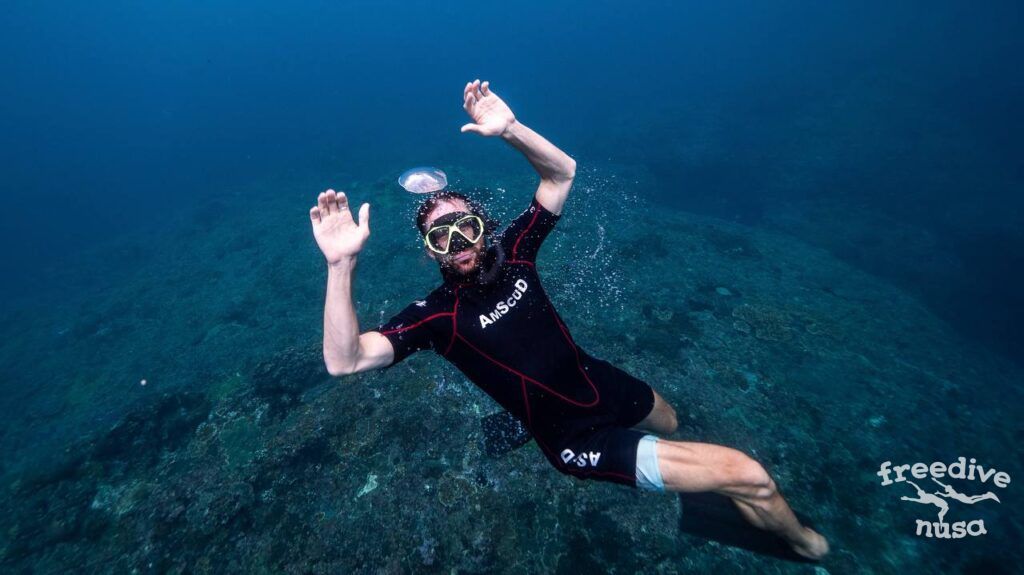
If you’re reading this because you’re curious about starting, here’s what we want you to know: you already have everything you need. Your body knows how to do this. Your lungs, your heart, your dive reflex – they’ve been waiting.
The only question is: are you ready to take that first breath and turn toward the blue?